 En
En
 русский
 Español
 عربى
عربى Deutsch
Precision Casting vs Machining for Complex Metal Parts
Industry News-Your design team just finished the CAD drawings for a complex metal part—something with intricate internal passages, thin walls, and geometries that would cost a fortune to machine from solid stock. You contact your manufacturing partner. They pull up the specifications and immediately ask: why not casting? At first, it sounds counterintuitive. Casting seems primitive compared to computer-controlled machining. Yet for complex-shaped components, the reality becomes obvious once you understand the physics involved. Precision casting processes represent one of manufacturing's most elegant solutions to creating intricate metal parts efficiently. Whether you're developing automotive components, industrial valve bodies, pump housings, or any complex geometry requiring metal construction, understanding why casting excels at solving this challenge changes how you approach component sourcing and manufacturing strategy.
What Makes Geometric Complexity So Challenging to Manufacture?
Traditional machining approaches begin with a solid block of material and remove everything that isn't the final part. Want a hollow chamber inside your component? The machine must drill through from the outside, creating access holes that later need sealing. Need intricate internal passages? Multiple drilling, boring, and reaming operations become necessary. Internal cooling channels? Each one demands separate tooling passes.
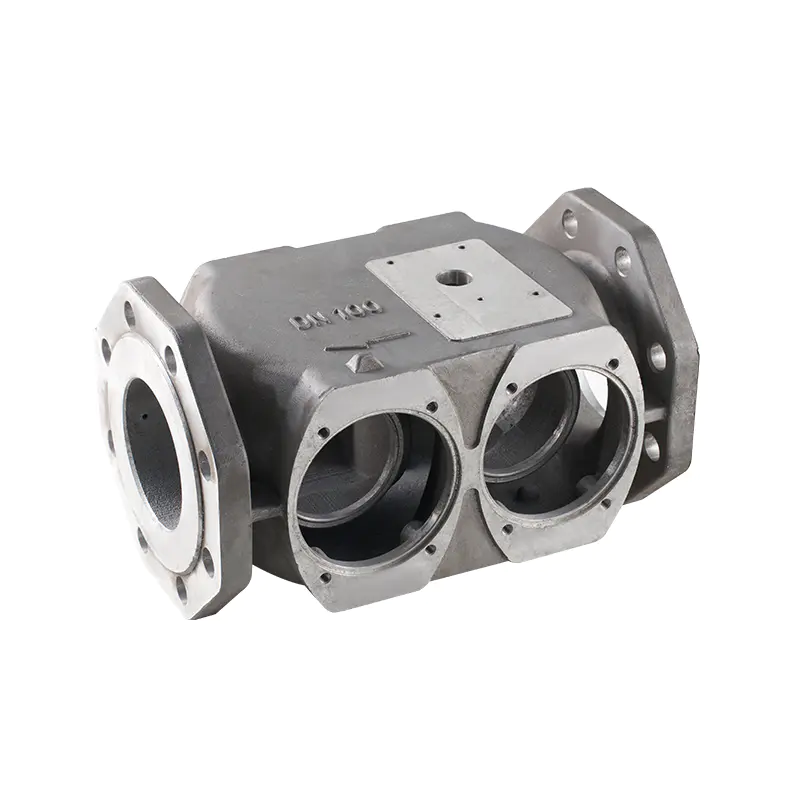
The mathematics works against traditional machining for genuinely complex shapes. A part requiring ten internal features means ten separate machine operations, each involving tool changes, setup time, and potential tolerance stack-up between operations. Material waste becomes considerable—perhaps fifty to seventy percent of your starting stock becomes chips on the shop floor. Production time extends significantly as technicians program, set up, and execute each operation sequentially.
Forging creates issues of its own. While forged components offer excellent strength properties, forge dies require either simple shapes or extreme force to compress complex geometries into metal. The pressure needed to fill intricate internal cavities often exceeds practical equipment limitations. Smaller features simply won't fill. Geometric undercuts become problematic. The cost of custom forge tooling for complex single-use components becomes prohibitive.
Then there's welded assembly. Manufacturers sometimes create complex components by fabricating multiple simpler pieces separately and joining them through welding. This introduces joint points—potential weakness locations requiring inspection and quality control. Each weld represents a process variation. Dimensional accuracy becomes harder to guarantee when multiple components must align and connect precisely.
How Does Precision Casting Solve These Challenges?
Casting operates on fundamentally different principles. Molten metal flows into a prepared cavity shaped exactly as your final component should appear. Internal passages? The mold cavity includes them from the start. Hollow chambers? They're core features within the mold itself. Complex geometry? That's precisely what casting embraces rather than fights.
A precision casting begins with a master model—typically made from wax or similar material. This model incorporates every geometric detail you require: undercuts, internal cavities, thin-wall sections, external features, everything. Surrounding this model is a ceramic shell, built through repeated dipping and coating processes. When heated, the wax melts and drains away, leaving a cavity that perfectly mirrors your component's intended shape.
Molten metal pours into this ceramic mold cavity. Gravity or other forces (vacuum, pressure) assist the metal flowing into every recess, filling the tiniest passages and settling into complex internal structures. Once cooled and solidified, you remove the ceramic shell and—remarkably—retrieve a single-piece component that already exists in nearly final form. No additional internal passages to drill. No internal surfaces requiring finishing. No joining operations necessary.
The mathematics inverts compared to traditional machining. You add only what's necessary for the process itself—minor surface finish requirements, perhaps minimal stock allowances for precision grinding if dimensional tolerance demands it. Your material utilization jumps dramatically. The casting process essentially shapes finished material rather than discarding most of it.
Comparing Manufacturing Approaches for Complex Geometries
| Manufacturing Method | Internal Features | Setup Complexity | Material Efficiency | Production Timeline | Tooling Cost | Quality Consistency |
|---|---|---|---|---|---|---|
| Traditional Machining | Difficult to produce; requires multiple machining passes | High | Poor (50–70% material waste) | Extended | Moderate | Varies with operator skill |
| Precision Casting | Naturally integrates complex internal features | Low | Excellent (minimal material waste) | Shorter | High initial investment | Highly repeatable |
| Die Casting | Limited to relatively simple internal features | Moderate | Good | Fast for high-volume production | High | Reliable |
| Sand Casting | Capable of moderate internal complexity | Moderate | Moderate | Moderate | Low | Variable |
| Forging | Very limited internal feature capability | High | Good | Extended | Very high | Good, where applicable |
| Welded Assembly | Possible through multi-part fabrication | High | Moderate | Extended | Moderate | Requires rigorous quality control |
This comparison reveals why precision casting dominates complex component manufacturing. It excels precisely where other methods struggle—when geometry becomes intricate and internal features multiply.
The Role of Precision Casting Process in Modern Manufacturing
Precision casting—sometimes called investment casting—has evolved significantly from its origins. Modern versions employ sophisticated control systems, advanced ceramic materials, and refined heating procedures. Computer-aided design now integrates with mold creation. Simulation software predicts metal flow patterns, identifying potential defects before production begins.
The process works through controlled heating and cooling. Furnaces maintain precise temperature windows allowing metal to flow freely without excessive turbulence or premature solidification. Mold materials balance permeability (allowing gas escape) with strength (containing liquid metal pressure). The ceramic shell composition determines how well heat transfers, influencing solidification patterns and final part properties.
For components requiring dimensional precision, secondary operations remain minimal. A light machining pass might address parting lines where mold sections separate. Surface grinding can achieve specific finish requirements. Threading operations, if needed, take moments since the bulk material shaping already occurred during casting.
Cost structure differs fundamentally from machining. Upfront mold development carries expense—creating the wax pattern equipment, preparing ceramic shell processes, optimizing heating parameters. But once established, each subsequent casting costs primarily the material and labor for pouring, cooling, and basic finishing. Volume production becomes progressively more economical. Even single complex castings sometimes cost less than machining equivalent geometry from solid stock.
When Internal Features Justify Precision Casting
Complex internal passages explain much of precision casting's appeal. Imagine an automotive part requiring coolant passages spiraling through its structure—something impossible to machine without drilling from outside and subsequently sealing access holes. A pump housing with multiple internal chambers? Each chamber represents simplified geometry when cast as an integrated cavity rather than machined separately and joined.
Electronic component enclosures often contain internal ribs, bosses, and mounting points that reinforce the structure while maintaining light weight. Casting creates these features naturally during solidification. Heat sinks require precise internal fin geometries for fluid flow optimization. Precision casting handles these specifications effortlessly.
Hydraulic and pneumatic components frequently contain complex internal passages directing fluid flow. Casting allows engineers to create these paths as single, integrated structures. Quality and performance become more reliable than if multiple components were machined and connected through manifold blocks.
Automotive engine components demonstrate this reality. Cylinder heads contain intricate coolant passages, valve guides, and oil galleries running through complex internal pathways. While machining individual features is possible, doing so requires numerous separate operations. Casting integrates everything into a single coherent component.
Achieving Quality and Precision with Cast Components
Common misconceptions suggest casting produces rough, imprecise components requiring extensive finishing. Modern precision casting reality differs significantly. With proper process control, dimensional variations fall within acceptable ranges directly from the mold, often within fractions of a millimeter.
Surface finish depends primarily on mold material properties and pouring temperature control. Ceramic shells with appropriate surface preparation produce castings with smoothness acceptable for many applications without additional work. Where tighter finish requirements exist, light grinding or polishing removes minimal material—seconds or minutes per surface rather than the hours machining identical geometry might require.
Porosity—small gas pores within the casting—can be minimized through vacuum-assisted casting, pressure assists during pouring, and controlled cooling rates. Computer modeling now predicts where porosity might form, allowing process adjustments before production begins. Vacuum casting techniques nearly eliminate porosity when properly executed.
Mechanical properties of cast components compare favorably with machined equivalents. Material removal through machining sometimes introduces surface stresses or removes beneficial grain structures. Casting, conversely, develops favorable crystalline structures during controlled cooling. The result: comparable or superior strength characteristics despite originating from liquid metal.
Material Selection for Casting Complex Components
Different casting materials suit different applications. Aluminum castings offer weight advantages for aerospace and automotive applications where mass matters. Aluminum also casts readily into complex geometry with good dimensional accuracy. The material cools relatively quickly, reducing total production time per component.
Steel castings provide strength advantages for high-load applications. Heavy machinery, large valve bodies, and components experiencing significant thermal cycling benefit from steel's thermal stability and mechanical properties. Steel castings withstand higher temperatures and stresses compared to aluminum equivalents.
Brass and bronze castings suit applications requiring corrosion resistance or aesthetic appeal. Plumbing fixtures, marine hardware, and decorative components frequently employ these materials because they resist seawater corrosion and maintain attractive appearance without coating.
Stainless steel castings balance corrosion resistance with strength. Food processing equipment, chemical handling systems, and medical device components often require this combination. Stainless steel's higher melting temperature demands more careful process control, but the material's properties justify the additional complexity.
Why Die Casting Occupies a Distinct Niche
Die casting differs from precision casting in fundamental ways. Die casting uses high pressure to force molten metal into hardened steel dies—essentially stamping metal into shape under extreme pressure. This process excels for high-volume production of relatively simple shapes.
Die casting parts cool rapidly due to large thermal mass in steel dies. Production cycles compress to seconds or minutes per component. Component tolerances remain consistent across thousands of identical parts. For high-volume automotive parts, consumer electronics housings, or similar commodity components, die casting economics are difficult to match.
However, die casting struggles with complex internal features. Steel dies have structural limits. Undercuts become problematic because the die must somehow open and eject the part without damage. Internal passages require careful engineering—essentially core pins that must collapse and retract during ejection. The complexity of such dies becomes prohibitively expensive for anything but high-volume production.
Precision casting, by contrast, accepts intricate internal geometry easily. The single-use ceramic shell accommodates any cavity geometry without concern for mechanical ejection requirements. This makes precision casting economical even for low volumes or one-off components with complex internal features, while die casting remains expensive for such applications.
Applications Demanding Casting Expertise
Automotive manufacturing represents a major consumer of precision castings. Engine manifolds route exhaust gas through complex paths. Transmission housings contain internal galleries distributing oil to specific locations. Differential cases incorporate complex internal structures while maintaining strength for load transmission.
Pump and compressor components demonstrate casting's suitability for fluid-handling applications. Pump housings contain multiple cavities, internal passages directing liquid flow, and mounting points for shafts, impellers, and covers. Precision casting produces these complete units from single castings, eliminating leakage paths that multiple-piece assemblies would introduce.
Industrial valves require sophisticated internal geometries controlling fluid flow. Ball valve bodies, check valve housings, and proportional control valve manifolds all employ precision casting to achieve necessary internal passages and sealing surfaces in single components.
Medical and dental equipment relies on casting for components with both functional complexity and aesthetic requirements. Surgical instruments containing multiple internal features, pump housings for laboratory equipment, and structural components of diagnostic devices frequently employ this manufacturing method.
Aerospace components benefit from casting's ability to integrate complex geometry while maintaining tight weight control. Titanium and superalloy castings form intricate structural elements, duct systems, and mounting structures in jet engines where both performance and weight control are critical.
Cost Justification and Economic Considerations
Initial tooling investment for precision casting appears substantial. Creating wax pattern equipment, developing ceramic shell procedures, establishing proper heating parameters—these activities require engineering expertise and testing. For single-component projects, this upfront cost might seem excessive.
Yet economics shift dramatically with volume. After initial setup, each additional casting costs primarily material and labor. No new tooling creation. No additional engineering. Producing five castings costs minimally more than producing one after tooling is complete. Compare this with machining, where each component requires similar setup time and labor regardless of quantity produced.
The decision equation simplifies for genuinely complex geometry: if a component's internal features make machining expensive, casting usually proves economical even for small production runs. If geometry is simple enough that machining remains cheap, perhaps casting adds no economic value. But that middle ground—components too complex to machine economically but not complex enough to justify die casting tooling—is precisely where precision casting creates value.
Maintenance and repair scenarios sometimes justify casting economically. A single replacement component for aging equipment might use casting even though initial high-volume production used different methods. Casting can reproduce complex original geometry without expensive retooling for traditional methods.
Process Integration and Supply Chain Considerations
Selecting a casting parts manufacturer requires understanding their specific capabilities. Different foundries specialize in different material types, size ranges, and complexity levels. Some excel with aluminum castings up to particular weights. Others specialize in steel or stainless steel castings. Ceramic shell mold creation skills vary among suppliers.
Quality systems matter considerably. Reputable manufacturers employ process controls ensuring repeatability. Pressure monitoring during pouring, temperature recording throughout cooling cycles, X-ray inspection for porosity—these quality measures vary among suppliers. Understanding your specific requirements informs supplier selection.
OEM casting parts supply chains benefit from integrated planning. Early communication between component designers and casting manufacturers can optimize mold design for actual production requirements. Sometimes subtle geometry modifications ease casting processes while maintaining functional requirements. This collaborative approach reduces tooling costs and improves part quality.
Volume forecasting influences supplier relationships. Committing to anticipated volumes helps casting manufacturers manage tooling investment and operational planning. Conversely, unexpected volume increases create capacity challenges. Regular communication about anticipated production levels supports mutually beneficial relationships.
Modern Technology Enhancing Casting Capabilities
Computer simulation now predicts metal flow through molds before actual production. Software models show where turbulent flow might introduce defects, where metal might solidify prematurely trapping gas, how temperature gradients develop during cooling. Engineers modify mold geometry or process parameters based on simulation results, dramatically reducing development time and improving first-article quality.
3D printing technology now creates wax patterns faster and more reliably than traditional methods. Complex geometries that would require painstaking hand-carving now emerge directly from printer output. This accelerates development timelines and enables geometric complexity that manual methods would reject as impractical.
Real-time monitoring systems track casting performance through production. Temperature sensors, pressure transducers, and imaging systems record actual process conditions. Data analysis identifies trends before parts degrade in quality, triggering corrective actions proactively rather than reacting to defects.
Alloy development continues expanding material options for casting. New aluminum compositions offer improved castability with reduced porosity. Specialty steels provide strength-to-weight ratios previously unattainable. Titanium and magnesium casting capabilities improve steadily, enabling lightweight aerospace and defense applications.
Making Informed Decisions About Casting Versus Alternatives
Evaluate your specific components systematically. Do internal features make them candidates for casting? Calculate the machining time required if traditional methods were attempted—include tool changes, setup, operator supervision. Compare that against casting development plus per-unit casting costs.
Consider your production volume. High-volume commodity components might favor die casting's speed and consistency. Low-volume complex components often justify precision casting's flexibility. Medium volumes sometimes split between options—perhaps die casting the simple housing and casting or machining the complex internal elements separately, then assembling.
Material requirements influence decisions. If aluminum's lightweight properties satisfy functional needs, aluminum casting costs less than steel alternatives. Corrosion resistance needs? Stainless steel or bronze castings address this without additional coating steps. Operating temperature range? Some materials retain properties better under specific thermal conditions.
Quality tolerance demands matter significantly. If surface finish or dimensional precision requirements exceed what casting can economically deliver, secondary operations become necessary. Light grinding or precision machining can achieve tight tolerances when casting provides near-net-shape geometry requiring minimal material removal.
Connect with experienced casting suppliers early in component development. Their expertise often identifies optimizations reducing costs while improving manufacturability. Engineers designing components without manufacturing process knowledge sometimes create unnecessary complexity that experienced foundry personnel would modify. Ruian Huazhu Machinery Co., Ltd. brings extensive experience developing casting solutions for complex component applications across diverse industries. Their precision casting capabilities span aluminum, steel, and specialty alloy materials serving automotive manufacturers, pump suppliers, valve manufacturers, and industrial equipment builders. Whether you're developing new components, transitioning production methods to improve economics, or seeking suppliers capable of delivering complex castings reliably, their technical expertise guides decision-making through component development and production phases. Connecting with their engineering team early in component design enables optimization balancing functional requirements against manufacturing efficiency. Reach out to discuss your specific complex geometry challenges and explore how precision casting might improve your manufacturing approach while reducing costs and development timelines.
Related products
-

The HZ700-C Fully Automatic Core Shooter With Core Pulling is an advanced molding solution designed ...
See Details -

The Fully Automatic Environmentally Friendly Core Shooting Machine is a highly advanced, eco-conscio...
See Details -

The HZ700-X Fully Automatic Core Shooting Machine With Lower Mold Removal is designed to make core p...
See Details -

The HZ700-X Fully Automatic Core Shooting Machine With Lower Mold Removal is designed for molding ap...
See Details -

The HZ800-X Hydraulic Fully Automatic Core Shooting Machine is designed for efficient and accurate c...
See Details -

The environmentally friendly core shooting machine with lower mold removable is a high-performance s...
See Details -

The Lower Mold Removable Type Environmentally Friendly Core Shooting Machine with Door is an advance...
See Details -

The HZ800-X Hydraulic Environmentally Friendly Core Shooting Machine is an advanced automatic core p...
See Details

Welcome to our company to design according to your design and sample proofing.
Contact Infor
-
 Haixi Town, Pingyang County, Wenzhou City, Zhejiang Province, China
-
 +86-13868387823
-
 +86-577-65197155
-
 +86-577-65197166
-
 13868387823@139.com
huazhultd@outlook.com
Quick Links
Products
Copyright © Ruian Huazhu Machinery Co., Ltd. All Rights Reserved.

