 En
En
 русский
 Español
 عربى
عربى Deutsch
How to Choose Casting Parts in Automobile Wisely?
Industry News-Selecting the wrong casting process for an automotive component does not always show up immediately. Sometimes the problem surfaces after tooling has been committed, after a supplier relationship has been established, or worse — after parts have already entered production and quality issues begin accumulating. Engineers and procurement teams working across automotive supply chains encounter this challenge regularly: the pressure to move fast, combined with an incomplete understanding of how different casting methods map to different performance requirements, produces specification decisions that cost more to fix than they would have cost to get right at the outset. Working with an experienced Casting Parts Manufacturer from the evaluation stage rather than the ordering stage changes that dynamic significantly.
Why Automotive Casting Selection Is More Complicated Than It Appears
The Performance Requirements Are Rarely Simple
An automotive component is not just a shaped piece of metal. It exists within a system — thermal, mechanical, structural — and its casting specification needs to account for what that system will ask of it over the vehicle's full service life. Vibration loads, temperature cycling, corrosive exposure, fatigue from repeated stress, and the consequences of failure all vary dramatically between a decorative interior bracket and a structural suspension component.
The mistake that causes the most trouble is treating casting selection as a material question alone. Material matters, but process matters just as much. The same aluminum alloy processed through die casting versus precision casting will behave differently in service, carry different tolerance capabilities, and suit different production volume requirements. Understanding that combination — material plus process plus application context — is where sound selection begins.
Automotive Standards Add a Layer That General Casting Guidance Ignores
General casting selection guidance does not account for automotive-specific requirements around traceability, dimensional validation, fatigue life documentation, and the procedural controls that automotive supply chains demand. A Die Casting Parts Supplier that serves general industrial markets may not have the process discipline, documentation capability, or inspection rigor that automotive OEM qualification requires.
This is not a minor gap. Automotive certification processes exist because the consequences of component failure in a vehicle are different from the consequences in most other applications. Selecting a casting partner without verifying their automotive experience and quality system is a risk that often becomes apparent too late in the development cycle.
Material Selection: Where the Process Conversation Begins
Aluminium Casting Parts in Automotive: Lightweight Without Sacrificing Structural Integrity
Aluminium has become the dominant casting material in automotive applications, and the reasons extend beyond weight reduction alone. Aluminium Casting Parts offer a combination of properties that aligns well with where vehicle engineering has been moving: lower mass for improved fuel efficiency and EV range, adequate strength for most structural applications, good thermal conductivity for components near heat-generating systems, and recyclability that supports circular economy requirements from automotive OEMs.
Die casting is the process most commonly applied to aluminium in high-volume automotive production. It produces consistent dimensional accuracy across large quantities, achieves surface finishes that often require minimal post-processing, and supports cycle times that make per-part cost viable at automotive scale.
Where aluminium die casting has limitations is in wall thickness consistency for complex geometries, porosity control in sections that will be machined or pressure-tested, and the investment required for tooling at production scale. These limitations influence which components suit die casting and which are better addressed through alternative approaches.
Brass Casting Parts: A Specialized Role in Automotive Systems
Brass is not the material most people think of first for automotive casting, but it occupies specific application niches where its properties are genuinely difficult to replace. Brass Casting Parts offer strong resistance to corrosion in environments where moisture, fuel, or hydraulic fluid contact is ongoing. They also machine cleanly to tight tolerances and maintain dimensional stability in applications where thermal cycling produces stresses that would cause other materials to distort over time.
Valve bodies, fittings in fluid systems, electrical connectors, and certain sensor housings are areas where brass appears in automotive applications. The material cost is higher than aluminium, which limits its use to components where the performance case justifies the premium. Understanding when brass genuinely performs better — versus when aluminium with appropriate surface treatment would serve equally well — is a real engineering judgment that affects both performance and total component cost.
Steel and Alloy Casting for High-Strength Requirements
For components where strength-to-weight ratio considerations favor strength over weight reduction, steel and iron alloy castings remain relevant in automotive applications. Heavy-duty structural brackets, certain suspension components, and powertrain housings where thermal and mechanical demands exceed what aluminium alloys can reliably sustain represent the typical domain.
The tradeoff is density — steel castings add weight that aluminium cannot, which matters in the overall vehicle mass budget. The engineering decision is whether the strength requirement genuinely demands steel or whether a well-engineered aluminium design can meet the load case with appropriate geometry changes.
Casting Process Selection: Matching the Method to the Component
Die Casting: High Volume, Consistent Geometry, Tight Tolerances at Scale
Die casting forces molten metal under pressure into a precision-machined mould, producing near-net-shape parts with good dimensional consistency. For automotive applications involving high production volumes — engine housings, gearbox cases, structural nodes in vehicle body architecture — die casting is the process that makes the economics work.
The strengths of die casting in automotive context:
- Dimensional repeatability across large production runs
- Surface finish quality that reduces downstream machining requirements
- Capability to produce thin walls and complex internal features
- Cycle times that support automotive production volumes
The constraints that matter in specification:
- Tooling investment is substantial and front-loaded, which affects project economics at lower volumes
- Porosity in thicker sections can be a concern for components that are pressure-tested or heavily machined
- Design constraints around draft angles and parting lines affect what geometries are achievable
Die Casting Parts Manufacturers with automotive experience will guide design teams through these constraints during the development phase, which is why early engagement with the manufacturing partner matters more in die casting than in some other processes.
Precision Casting and Lost Wax Casting Parts: Complexity Without Compromise
Lost wax casting, also called investment casting or the Precision Casting Process, builds a ceramic shell around a wax pattern of the desired part, melts the wax out, and fills the resulting cavity with molten metal. The process produces parts with geometric complexity and surface detail that other casting methods cannot match, and it achieves dimensional accuracy that reduces or eliminates machining on many features.
For automotive applications, the Precision Casting Process is appropriate when:
- The component geometry includes internal passages, undercuts, or features that die casting cannot produce without extensive secondary operations
- The production volume is lower and tooling investment needs to be lower accordingly
- The application is safety-critical and requires tight tolerances throughout — not just on machined surfaces
- The part design has been optimized for function rather than adapted to manufacturing constraints
Lost wax casting parts for automotive applications appear in turbocharger components, precision-machined valve bodies, fuel system hardware, and sensor housings where accuracy and internal geometry complexity combine in ways that other processes cannot address as efficiently.
OEM Casting Parts: Customization Within a Production Framework
OEM Casting Parts refers to components produced according to buyer-provided specifications, drawings, and quality requirements — as opposed to standard catalog castings. In automotive supply chains, virtually all structural and functional casting components are OEM in nature, because vehicle design does not accommodate generic parts in load-bearing or safety-related positions.
The relevant distinction for specification purposes is between OEM die casting and OEM precision casting. Both involve custom tooling and custom quality planning to the buyer's requirements, but they serve different applications based on the volume, geometry, and tolerance arguments laid out above.
Working with an OEM Casting Parts supplier in automotive applications requires verifying their capability in several dimensions beyond production process. Process control documentation, statistical quality methods, dimensional traceability systems, and the supplier's experience with automotive customer requirements all affect whether OEM supply relationships produce the consistency that automotive assembly operations require.
Application Mapping: Which Casting Approach Fits Which Vehicle System?
Different vehicle subsystems place genuinely different demands on their casting components. A one-size approach to process and material selection across the full vehicle does not work.
| Vehicle Subsystem | Typical Casting Application | Suitable Process | Key Selection Driver |
|---|---|---|---|
| Powertrain / Engine | Block, head, housing, brackets | Aluminium die casting | Volume, thermal performance, weight |
| Transmission | Gearbox casing, housings | Aluminium die casting | Precision, sealing requirements |
| Suspension / Chassis | Knuckles, control arm nodes | Aluminium or steel casting | Strength, fatigue resistance, safety |
| Fuel and fluid systems | Valve bodies, manifolds, fittings | Precision casting, brass casting | Internal geometry, pressure integrity |
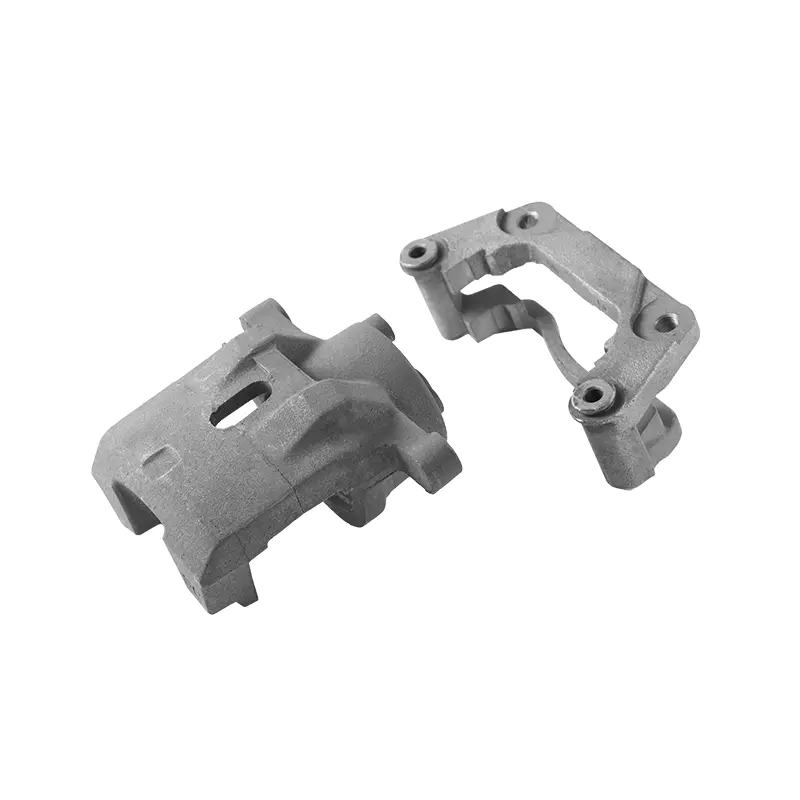
| Braking systems | Caliper bodies, brackets | Aluminium die casting or precision | Heat resistance, dimensional accuracy |
| Electrical systems | Connector housings, sensor bodies | Precision casting, small metal parts | Tolerance, surface finish, complexity |
| Interior structural | Seat frames, HVAC housings | Aluminium die casting | Cost, volume, appearance |
| EV battery structure | Battery tray components, housings | Aluminium die casting | Weight, thermal management, sealing |
This mapping is a starting reference rather than a rigid prescription. Individual component designs, load cases, and production volume requirements will move specific parts within and between these categories. The point is that vehicle subsystem context provides a useful frame for beginning the process selection conversation before diving into component-level detail.
The Lightweight Imperative and Its Effect on Casting Selection
How EV Development Has Reshaped Material Priorities
Electric vehicle architecture has accelerated trends in casting selection that were already visible in conventional vehicle engineering. Battery mass is a fixed constraint in EV design — it cannot be reduced without compromising range — which means every other system in the vehicle is under pressure to contribute to overall weight reduction in ways that combustion engine vehicles did not require to the same degree.
Aluminium Casting Parts have moved from a weight-reduction strategy to a near-baseline assumption for structural and powertrain components in EV platforms. The casting processes used to produce those aluminium parts are evolving alongside the weight targets: larger single-piece castings that replace multiple assembled parts, thinner walls enabled by advances in die casting pressure and alloy development, and integrated designs that combine what were previously separate components.
For procurement teams and engineers specifying casting components in EV applications, the lightweight requirement is not a background consideration — it actively shapes which alloys are acceptable, which wall thicknesses are achievable, and which suppliers have the process capability to produce what the design demands.
Cost Versus Safety: The Tradeoff That Defines Automotive Casting Decisions
When Cost Pressure and Safety Requirements Pull in Opposite Directions
Automotive production operates under cost pressure at every tier of the supply chain. The response to that pressure sometimes produces specification decisions that favor lower process costs without adequately accounting for the safety implications of the application. This is where the casting selection decision becomes genuinely consequential rather than simply technical.
Components in safety-critical applications — braking systems, steering linkages, suspension structural members — cannot be evaluated on per-unit cost alone. The right framework for these components adds reliability requirements, fatigue life targets, failure mode analysis, and the cost implications of failure in service. When those factors are in the calculation, the economic case for a higher-process-cost casting method often becomes clear.
Non-safety-critical components — housings, decorative brackets, non-structural covers — have more flexibility in process selection and cost-performance tradeoffs. Understanding which category a component falls into is not always obvious from the drawing alone. The mechanical load case, the failure mode, and the consequences of dimensional deviation in service all inform that judgment.
Casting Small Metal Parts for interior or electrical applications often falls into the lower-criticality category, where die casting or precision casting are selected based on volume and geometry rather than safety hierarchy. But even in these applications, dimensional consistency and surface quality matter for assembly fit and function — which means process selection is never entirely disconnected from performance requirements.
Evaluating a Casting Parts Supplier for Automotive Work
What Capability Verification Actually Involves
Finding a Die Casting Parts Supplier or precision casting company with automotive experience is not the same as verifying that they can actually deliver what an automotive application requires. The gap between claimed capability and demonstrated capability is real, and closing it before commitment protects the project timeline and the eventual product quality.
Practical verification steps for automotive casting supplier evaluation:
- Process audit: Review the production process against the casting method requirements for the specific component — equipment condition, process parameter control, and operator consistency
- Quality system documentation: Verify the supplier has a documented quality management system with inspection records, non-conformance handling, and corrective action processes
- Dimensional capability evidence: Request process capability data on dimensions relevant to the component design, not just generic accuracy claims
- Material traceability: Confirm the supplier can trace materials from incoming certification through production to outgoing product, which is a baseline requirement for automotive supply
- Sample and prototype history: Review examples of similar automotive components the supplier has produced, including any issues encountered and how they were resolved
- Communication and responsiveness: The supplier's behavior during the evaluation process is predictive of their behavior during production — slow, vague, or defensive responses during qualification are not good signs
China Casting Parts suppliers have expanded their automotive capability significantly, and many now operate with quality systems and production controls that meet international automotive requirements. The evaluation process above applies equally regardless of supplier geography — what matters is demonstrated capability, not location.
A Practical Selection Framework
How to Structure the Decision Before Engaging Suppliers
Approaching casting selection as a structured decision process rather than a sequential set of individual judgments produces better outcomes. A useful sequence:
- Define the application context — which vehicle subsystem, what load conditions, what failure consequences
- Establish the safety classification — safety-critical, functional, or non-structural
- Set material requirements — based on weight targets, thermal environment, corrosion exposure, and strength requirements
- Identify the production volume — which process economics make sense at the planned quantity
- Evaluate geometric complexity — which casting processes can produce the design as drawn, and which require design modifications
- Define tolerance and surface finish requirements — which will determine process capability requirements for supplier selection
- Assess certification requirements — what automotive quality documentation the OEM or tier-one customer will require
- Identify supplier candidates — based on process capability, automotive experience, and geographic and logistics fit
Working through this framework before contacting suppliers means the conversations are more productive from the start — and the supplier responses are easier to evaluate against actual requirements.
Casting selection for automotive applications is rarely a single question with a clean answer. It is a set of interconnected decisions about material, process, volume, geometry, and supplier capability that interact with each other in ways that are not always obvious at the outset. The teams that navigate it well tend to be those who engage the manufacturing question early in the design process rather than late, who understand the performance implications of process choices rather than treating them as interchangeable, and who evaluate suppliers against actual automotive requirements rather than general production claims. Ruian Huazhu Machinery Co., Ltd. manufactures casting parts for automotive and industrial applications, with capabilities spanning die casting, precision casting, and OEM casting part production in aluminium, brass, and other materials. For engineering teams and procurement professionals working through casting selection for current or upcoming automotive projects, reaching out to their technical team for a capability discussion and application review is a practical way to move from specification questions to verified sourcing options.
Related products
-

The HZ700-C Fully Automatic Core Shooter With Core Pulling is an advanced molding solution designed ...
See Details -

The Fully Automatic Environmentally Friendly Core Shooting Machine is a highly advanced, eco-conscio...
See Details -

The HZ700-X Fully Automatic Core Shooting Machine With Lower Mold Removal is designed to make core p...
See Details -

The HZ700-X Fully Automatic Core Shooting Machine With Lower Mold Removal is designed for molding ap...
See Details -

The HZ800-X Hydraulic Fully Automatic Core Shooting Machine is designed for efficient and accurate c...
See Details -

The environmentally friendly core shooting machine with lower mold removable is a high-performance s...
See Details -

The Lower Mold Removable Type Environmentally Friendly Core Shooting Machine with Door is an advance...
See Details -

The HZ800-X Hydraulic Environmentally Friendly Core Shooting Machine is an advanced automatic core p...
See Details

Welcome to our company to design according to your design and sample proofing.
Contact Infor
-
 Haixi Town, Pingyang County, Wenzhou City, Zhejiang Province, China
-
 +86-13868387823
-
 +86-577-65197155
-
 +86-577-65197166
-
 13868387823@139.com
huazhultd@outlook.com
Quick Links
Products
Copyright © Ruian Huazhu Machinery Co., Ltd. All Rights Reserved.

