 En
En
 русский
 Español
 عربى
عربى Deutsch
Home / News / Industry News / How Do Vertical Parting Core Shooting Machines Function and What Should Buyers Consider?
How Do Vertical Parting Core Shooting Machines Function and What Should Buyers Consider?
Industry News-Vertical parting core shooting machines are essential in foundry operations, particularly for producing high-quality sand cores used in metal casting. These machines automate the process of forming sand cores by compacting sand in a mold around a core box, allowing precise and repeatable production. They are widely used in automotive, aerospace, and industrial metal castin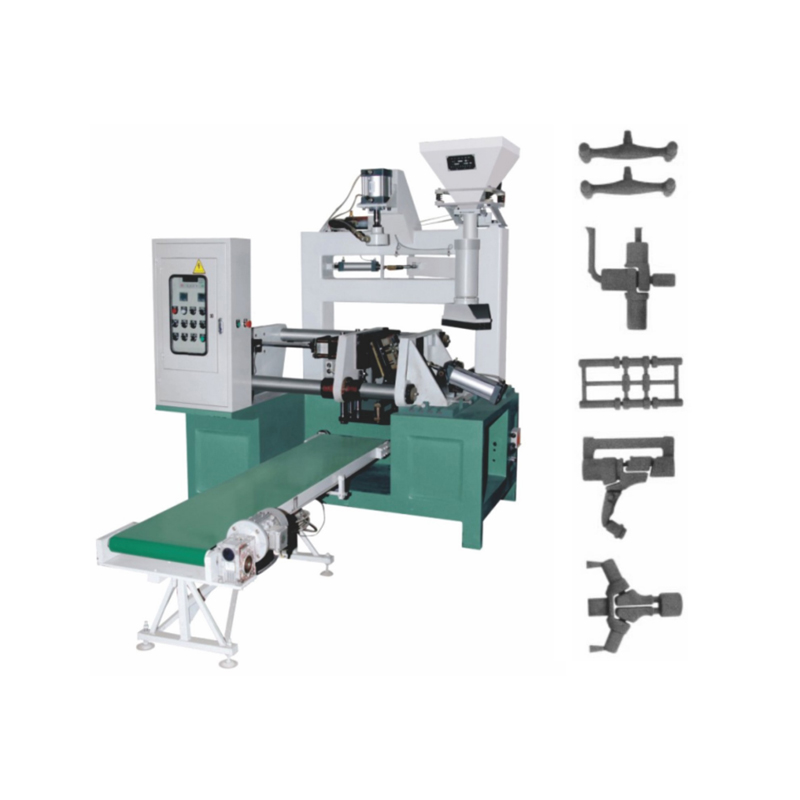 g applications.
What is the Role of a Vertical Parting Core Shooting Machine in Foundry Operations?
Vertical parting core shooting machines perform several important functions within sand core production:
Sand Feeding and Distribution
Sand is delivered to the core box from a hopper or feeding system, ensuring a consistent material supply for each shot.
Compaction and Shooting
The machine compacts sand using controlled air pressure or mechanical ramming, filling the core cavity completely and evenly.
Parting Line Management
Vertical parting machines align core boxes along a precise parting line, ensuring correct formation of complex core geometries.
Repetition and Consistency
Automated operation allows multiple cores to be produced with uniform density, shape, and surface finish, reducing variability in casting.
Cycle Time Optimization
By automating sand loading, compaction, and ejection, these machines reduce manual labor and shorten production cycles.
Integration with Core Baking or Curing Systems
Some vertical parting core shooting machines are designed to feed cores directly to curing ovens, enhancing overall foundry workflow efficiency.
These functions make vertical parting core shooting machines critical for foundries requiring consistent, high-quality cores, especially when complex geometries or high-volume production are involved.
How Do Vertical Parting Core Shooting Machines Improve Sand Core Quality?
Uniform Density and Strength
Controlled Sand Compaction
Vertical parting core shooting machines apply uniform pressure to sand during shooting, resulting in consistent density throughout the core. This reduces weak points that can fracture during metal pouring.
Reduced Segregation
Properly calibrated air or mechanical ramming minimizes sand segregation, preventing coarse or fine particles from clustering and ensuring homogeneous core structure.
Surface Finish and Accuracy
Precise Parting Alignment
Vertical machines maintain accurate parting line alignment, producing cores that match design specifications. This precision reduces flash and misalignment during casting.
Smooth Core Surfaces
Uniform compaction prevents rough or uneven surfaces, which can affect the final casting’s dimensional accuracy and finish.
Consistency Across Multiple Cores
Repeatable Production
Automated systems reduce human variability, producing cores with consistent mechanical properties.
Optimized Cycle Time
Consistent timing of sand feeding, compaction, and ejection contributes to uniform thermal and structural characteristics after curing.
Through controlled compaction, precise parting alignment, and repeatable processes, vertical parting core shooting machines significantly enhance the mechanical strength, surface finish, and dimensional consistency of sand cores.
What Are the Key Features to Look for When Buying a Vertical Parting Core Shooting Machine?
Core Size Capacity
Ensure the machine can handle the largest core dimensions you plan to produce. Larger shot chambers and adjustable parting mechanisms increase flexibility.
Compaction Control
Look for machines with adjustable air pressure, mechanical ramming force, or both. Precise control allows uniform core density and reduces sand wastage.
Automation and Cycle Management
Advanced machines provide programmable cycle times, automated sand feeding, and synchronized ejection. Automation improves efficiency and reduces operator error.
Ease of Maintenance
Removable liners, accessible ramming systems, and straightforward lubrication points simplify routine maintenance, reducing downtime.
Material Compatibility
Ensure compatibility with different types of core sand, binders, and additives used in your foundry. Some machines handle only specific sand formulations.
Safety Features
Overpressure protection, emergency stop switches, and interlocks protect operators and prevent damage to the machine during operation.
Integration Capabilities
Consider machines that can connect with curing ovens, conveyors, or robotic systems to streamline the overall core production workflow.
By evaluating these key features, foundries can select a vertical parting core shooting machine that meets production volume requirements, maintains core quality, and supports long-term operational efficiency.
Related products
-

The HZ700-C Fully Automatic Core Shooter With Core Pulling is an advanced molding solution designed ...
See Details -

The Fully Automatic Environmentally Friendly Core Shooting Machine is a highly advanced, eco-conscio...
See Details -

The HZ700-X Fully Automatic Core Shooting Machine With Lower Mold Removal is designed to make core p...
See Details -

The HZ700-X Fully Automatic Core Shooting Machine With Lower Mold Removal is designed for molding ap...
See Details -

The HZ800-X Hydraulic Fully Automatic Core Shooting Machine is designed for efficient and accurate c...
See Details -

The environmentally friendly core shooting machine with lower mold removable is a high-performance s...
See Details -

The Lower Mold Removable Type Environmentally Friendly Core Shooting Machine with Door is an advance...
See Details -

The HZ800-X Hydraulic Environmentally Friendly Core Shooting Machine is an advanced automatic core p...
See Details

Welcome to our company to design according to your design and sample proofing.
Contact Infor
-
 Haixi Town, Pingyang County, Wenzhou City, Zhejiang Province, China
-
 +86-13868387823
-
 +86-577-65197155
-
 +86-577-65197166
-
 13868387823@139.com
huazhultd@outlook.com
Quick Links
Products
Copyright © Ruian Huazhu Machinery Co., Ltd. All Rights Reserved.

