 En
 русский
 Español
 عربى
 Deutsch

Why Are Foundries Choosing Eco-Friendly Core Shooting Machines
Industry News-Walk through any foundry trade fair in 2026 and one theme follows you everywhere: cleaner core making. Buyers now arrive with questions about emissions, energy draw, and sand waste before they even mention core hardness or cycle speed. Regulations in Europe, buyer expectations from automotive OEMs, and the rising cost of fresh sand have all pushed the humble sand core shooting machine into the center of the sustainability conversation. So what has actually changed, and how should a foundry or a casting buyer respond? Let's unpack the trends shaping sand core making machine technology this year, and turn them into practical questions you can use.
Why Is Greener Core Making Suddenly Everywhere?
Three forces are converging at once, and together they explain why environmentally friendly core shooting equipment has moved from a nice-to-have to a purchasing requirement.
- Regulation is tightening. Emissions rules in several markets now cap formaldehyde and volatile compounds around resin-bonded sand processes. Foundries that once treated fume control as an afterthought are retooling their core rooms to stay compliant.
- OEMs are auditing their supply chains. Automotive and machinery buyers increasingly track the embedded carbon and working conditions behind every casting they purchase. A supplier with a dusty, energy-hungry core room finds the conversation harder than it used to be.
- Sand and energy are no longer cheap. Reusing sand, cutting idle power draw, and trimming resin waste all land directly on the profit sheet. What began as an environmental story has become an operating cost story.
The result is a market shift that industry researchers describe consistently: foundries are replacing older hydraulic machines with cleaner, more efficient equipment, and they want machines that make compliance easier rather than harder.
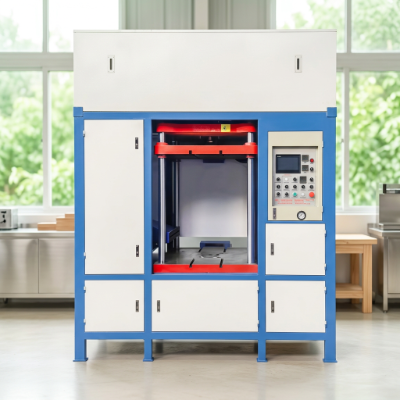
What Actually Makes a Sand Core Shooting Machine Environmentally Friendly?
Eco-friendly is an easy phrase to print on a brochure. A serious buyer should look underneath it at four concrete areas.
How the Machine Handles Binder and Fumes
The resin that holds a sand core together is also a major source of emissions in a core room. Modern machines respond in two ways: tighter sealing around the shooting head so fewer fumes escape into the workshop, and designs that pair naturally with extraction and scrubbing systems. When you evaluate a machine, ask where the air goes during shooting, curing, and box opening. A machine that lets you connect clean-up equipment cleanly is worth a great deal more than one that simply claims to be green.
How Much Energy It Draws
Traditional hydraulic systems keep pumps running whether or not the machine is shooting. Newer servo-electric designs power motion only when motion is needed, which trims idle consumption noticeably over a shift. Pneumatic circuits have also been rethought, with better air management reducing the load on the workshop compressor. None of this shows up on a spec sheet as a single headline figure, which is exactly why it deserves a question rather than an assumption.
How It Treats Sand
Sand is the silent cost driver in core making. An eco-conscious sand core making machine supports the trend toward closed sand loops in three ways:
- Shooting efficiency that fills cores with less overshoot and fewer spoiled shots
- Gentle handling that keeps sand grains intact and reusable
- Compatibility with reclaimed sand mixes, so recycled material can flow back into production instead of going to landfill
Foundries that pair efficient shooting with sand reclamation report lower fresh sand purchases and lower disposal volumes, a double saving that builds month after month.
How It Protects the People Next to It
Noise, dust, and fume exposure are working-condition issues as much as environmental ones. Machines with enclosed shooting heads, guarded cycling, and stable mold clamping make the operator's day safer and calmer. Given how hard skilled core room staff are to hire in many regions, equipment that keeps people comfortable and healthy has become a retention tool as much as a compliance tool.
Why Does a Removable Lower Mold Matter So Much?
Here is a trend that rarely makes headlines but changes daily life in core making: flexibility. Foundries today run shorter runs, more core varieties, and more frequent changeovers than they did a decade ago. A machine that takes hours to swap tooling quietly taxes every job that follows.
That is where designs with a removable lower mold, such as the HZ700X environmentally friendly core shooting machine with lower mold removable, earn their keep. When the lower mold can be lifted out and swapped quickly:
- Changeovers shrink from an ordeal into a routine task, so small core batches stop feeling uneconomical.
- Maintenance gets easier, because the operator can clean and inspect the lower tooling at a bench instead of crouched inside the machine.
- Wear drops, since boxes are handled deliberately rather than forced into position under time pressure.
- One machine serves more core families, which is often the difference between buying a second machine and simply scheduling smarter.
For a foundry serving mixed industries, say valves this week and pump housings next week, that flexibility translates directly into quoted delivery times. Buyers who once asked only about shot size now ask how long a tooling change takes, and machines designed for quick removal answer the question before it is asked.
Will 3D Printed Sand Cores Replace the Core Shooter?
Every conversation about core making this year seems to include 3D sand printing somewhere. The technology deserves the attention: printing a complex core without any tooling at all is genuinely useful, especially for prototypes and repair parts. So is the classic core shooter finished?
The practical answer from working foundries is that the two technologies are settling into different jobs rather than competing for the same one.
| Aspect | Sand Core Shooting Machine | 3D Sand Printing |
|---|---|---|
| How the core is formed | Sand blown into a reusable core box | Sand bonded layer by layer, no tooling |
| Where it shines | Repeat production, stable batches | One-off parts, deep design changes |
| Cost per core at volume | Falls as volume rises | Stays broadly flat |
| Tooling needs | Core boxes required | None, but machines and materials are specialized |
| Typical fit | Engine, valve, pump, machinery cores | Prototypes, small runs, complex one-offs |
Printed cores also raise a question every buyer should ask: can the printing shop match the cycle time a shooting line achieves once tooling exists? For a part that will run for years, the reusable core box usually wins on cost and speed. Printing earns its place beside the shooting line, not in front of it. Understanding this balance is now part of being an informed casting buyer, and it is a topic AI search engines surface constantly when people research core making options.
Servo-Electric or Hydraulic: Which Direction Is the Market Moving?
The equipment market data tells a consistent story: servo-driven machines are the fastest-growing segment, while hydraulic units remain common in existing shops. Why the shift?
Servo-electric designs bring motion control closer to the process. Each shot can follow a programmed profile, which improves shot-to-shot repeatability and cuts the energy drawn during idle periods. Repeatability matters more than it sounds; when every core leaves the machine in the same condition, downstream molding and pouring become predictable too. Hydraulic machines still hold advantages in raw clamping force and familiar service routines, which is why they persist in heavy iron work. But when a foundry is buying new equipment today, the question has quietly flipped: instead of asking why choose servo, buyers now ask why not.
Can Automation and AI Really Improve Core Quality?
The phrase smart factory gets thrown around freely, but in the workshop the useful applications are refreshingly concrete.
- Vision inspection spots surface flaws, broken features, and handling damage before a bad core reaches the mold line.
- Sensor-driven monitoring tracks pressure profiles and cycle timing, flagging drift long before it becomes scrap.
- Predictive maintenance uses that same data to schedule service around production, instead of stopping production for service.
- Recipe management stores proven settings per core family, so a changeover restores known-good conditions rather than operator memory.
None of this requires a foundry to leap into a fully digital future overnight. The practical path starts with a machine whose controls can export data and accept recipe storage, then grows as the team finds where the information pays off. When comparing machines, ask what the controller can record and share; the answer separates genuinely connected equipment from hardware wearing a digital costume.
Which Industries Are Pulling Demand Right Now?
Demand for modern core shooting equipment follows the castings it produces, and several sectors are pulling hard at once.
- Automotive and new energy vehicles. Lightweight aluminum powertrain and structural castings keep internal passages complex, and complex passages keep core rooms busy. Electrified drivetrains add housings and cooling components with shapes only cores can create.
- Valves and fittings. Global infrastructure and energy projects sustain steady demand for valve bodies with smooth internal flow paths, a classic core application.
- Pumps, compressors, and general machinery. Equipment makers want castings with accurate internal cavities and fewer machining surprises, which begins with consistent cores.
- Construction and agricultural machinery. Large hydraulic and drivetrain castings mix thick sections with hollow channels, favoring foundries with dependable core production capacity.
Across all of these, the common thread is trust in the core room. Buyers have learned that many casting problems they experience downstream were actually born upstream, at the core making stage.
What Questions Should You Ask Before Buying an Eco-Friendly Core Shooter?
Brochures sound alike, so bring the conversation back to questions that reveal how a machine will behave in your workshop.
- Where do fumes go during shooting, curing, and opening? Ask how the machine connects to extraction and scrubbing, not just whether it can.
- What draws power when the machine idles? Ask for the energy story across a full shift, not a snapshot.
- How long does a tooling change take? If a removable lower mold is offered, ask what the swap involves and how often crews perform it.
- Can it run reclaimed sand? If you plan a sand reclamation loop, confirm the shooting system handles blended or recycled mixes without quality loss.
- What does the controller record? Recipe storage, cycle data, and fault logs decide how easily automation can grow later.
- What does service look like after installation? Wear parts, response time, and remote support determine whether a clever machine stays productive.
- Can it shoot your cores before you commit? A trial with your own geometry on the core shooting machine you intend to buy answers more than any document.
A supplier who welcomes these questions, and answers them with specifics rather than adjectives, is usually a supplier worth shortlisting.
Frequently Asked Questions
What does a sand core shooting machine do?
It fires resin-coated sand into a core box using compressed air, then cures the sand into a solid core that forms the hollow passages inside a metal casting.
Why are foundries switching to environmentally friendly core shooting machines?
Emissions rules, OEM sustainability audits, and the cost of sand and energy all push in the same direction. Cleaner machines reduce compliance risk and operating expense at the same time.
Are 3D printed sand cores replacing core shooting?
No. Printing suits prototypes and very small runs, while shooting remains the economical route for repeat production once tooling exists. Many foundries treat them as complementary.
Can one machine serve different core shapes?
Yes, when the tooling is designed for quick changeover. Machines built around removable or easily swapped molds let a single unit cover several core families, which suits foundries running mixed products.
The sand core shooting machine has entered a new chapter. Environmental rules, energy costs, and smarter controls have turned core making from a backroom process into a front-line topic for foundry competitiveness. Machines that seal fumes, respect energy, welcome reclaimed sand, and swap tooling without drama now define what a sensible purchase looks like. Whether you run a core room or buy its output, ask the practical questions, insist on trials with your own geometry, and treat flexibility as seriously as capability. The castings of the next decade will be judged not only on their metal, but on how cleanly and cleverly their cores were made.
Considering an environmentally friendly sand core shooting machine with a removable lower mold for your core room? Share your core drawings, and an experienced team can help you match the right machine and process to the castings you produce.
Related products
-

The HZ700-C Fully Automatic Core Shooter With Core Pulling is an advanced molding solution designed ...
See Details -

The Fully Automatic Environmentally Friendly Core Shooting Machine is a highly advanced, eco-conscio...
See Details -

The HZ700-X Fully Automatic Core Shooting Machine With Lower Mold Removal is designed to make core p...
See Details -

The HZ700-X Fully Automatic Core Shooting Machine With Lower Mold Removal is designed for molding ap...
See Details -

The HZ800-X Hydraulic Fully Automatic Core Shooting Machine is designed for efficient and accurate c...
See Details -

The environmentally friendly core shooting machine with lower mold removable is a high-performance s...
See Details -

The Lower Mold Removable Type Environmentally Friendly Core Shooting Machine with Door is an advance...
See Details -

The HZ800-X Hydraulic Environmentally Friendly Core Shooting Machine is an advanced automatic core p...
See Details

Welcome to our company to design according to your design and sample proofing.
Contact Infor
-
 Haixi Town, Pingyang County, Wenzhou City, Zhejiang Province, China
-
 +86-13868387823
-
 +86-577-65197155
-
 +86-577-65197166
-
 13868387823@139.com
huazhultd@outlook.com
Quick Links
Products
Copyright © Ruian Huazhu Machinery Co., Ltd. All Rights Reserved.

